
To humanize AI content, edit it for a real reader: verify the claims, clarify the purpose, add supported detail, organize the argument, and review the finished page. Changing the tone alone cannot make an inaccurate article trustworthy.
This guide covers the full editorial pass from draft to publication. If you already have a sound article and need help with awkward sentences, use our seven fixes for robotic writing. The steps below are a proposed workflow, not a measured test of editing speed or AI detection.
1. Check the facts before polishing the prose
Mark numbers, quotations, dates, product specifications, and research claims. Open the underlying sources and confirm that they support the wording. Remove an unsupported claim or narrow it to match the evidence. Do not let a fluent rewrite turn a tentative finding into a promise.
Also check first-person statements: “I tested,” “we found,” and “our customers say” need real records. If no such evidence exists, remove the claim. A fictional example can still be useful when clearly labeled. Our source-verification guide explains the checks in more detail.
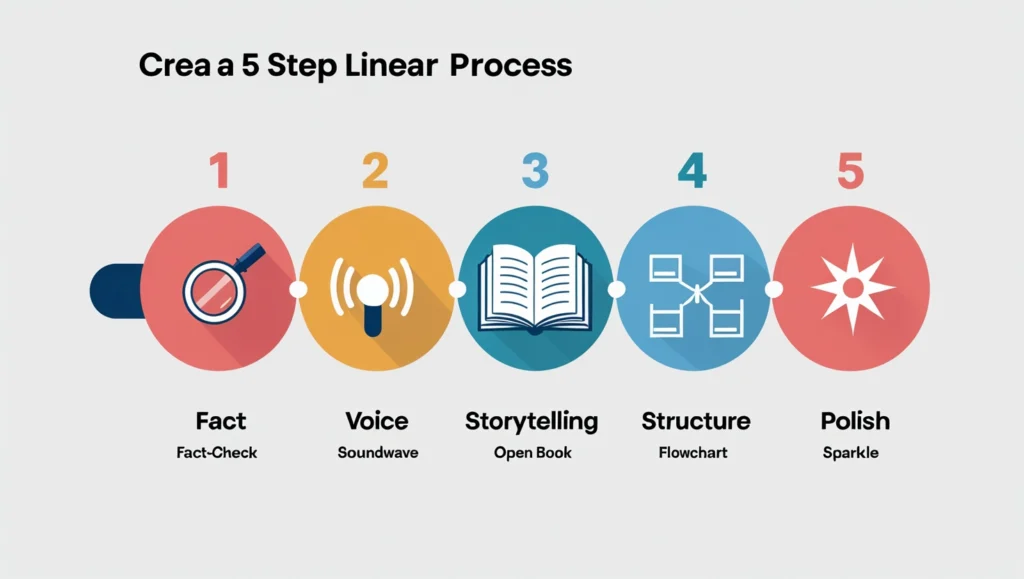
2. Decide what the reader needs from the page
Write one sentence describing the reader and the task: “This page helps a first-time blogger check a draft before publishing.” Compare each section with that purpose. Remove background that delays the answer and fill gaps that would prevent the reader from acting.
Do not expand the article just to reach a word count. A useful checklist, a qualified answer, or an honest limitation can matter more than another broad introduction. Google’s helpful-content guidance asks creators to assess usefulness, sourcing, and added value.
3. Add evidence and specific examples
Replace vague advice with details you can support. An approved process, a source passage, a documented comparison, or a labeled hypothetical example can make the explanation concrete. Personal stories are optional. Include one only when it happened and you can describe it accurately.
Illustrative example: Replace “AI transforms your workflow” with “Use AI to draft a summary from the supplied report, then compare each bullet with the source.” The revision describes an action. It does not invent a time saving, customer outcome, or first-hand test.
4. Edit the structure and voice without changing meaning
Put the answer near the start. Keep related points together and give headings descriptive names. Use words your audience understands, explain necessary technical terms, and remove repeated conclusions.
For voice, choose a few observable rules: direct openings, ordinary words, limited promotional adjectives, and examples relevant to the reader. A genuine writing sample can help communicate those preferences. Do not make a guide more “personal” by inserting invented memories or feelings.
Edit this draft for [audience] and [reader task].
Use the approved facts and voice sample below.
First identify unsupported claims and missing evidence; do not fill gaps.
Then revise the structure and wording.
Preserve qualifications, numbers, quotations, and attribution unless you flag a correction.
Do not invent personal experience, tests, testimonials, or results.
Return the revision and a short list of material changes.
DRAFT: [paste]
APPROVED FACTS AND SOURCES: [paste]
VOICE SAMPLE: [paste a sample you may use]
Review the revision against the original and its sources. An instruction to preserve facts is a requirement to check, not proof that the tool complied.

5. Review the final page before publication
- Read the title and opening: do they state what the page actually delivers?
- Follow the instructions yourself where practical and identify missing steps.
- Check that examples are labeled and quotations match their sources.
- Open internal and external links and confirm their destinations.
- Check the final images, captions, alt text, and any relevant disclosures.
- Read aloud for awkward phrasing, then review the formatted page on a small screen.
Reading aloud can reveal clumsy sentences, but it does not verify facts or prove authorship. Stop when the page meets its editorial requirements, rather than spending an arbitrary percentage of production time on editing.
Questions about humanizing AI text
Should I add mistakes to make writing seem human? No. Deliberate errors make the page harder to use. Focus on clarity, accuracy, and reader needs.
Should I keep rewriting until a detector approves? A detector score is not the publication standard used in this workflow. It does not establish that claims are supported, instructions are complete, or the article serves its reader. Follow any applicable authorship and disclosure requirements.
How long should editing take? It depends on the draft, source quality, topic, and required review. There is no universal editing time or percentage that guarantees quality.
For the earlier drafting stages, see writing an article with ChatGPT. For specific sentence repairs, continue with before-and-after examples for robotic text.
Sources and editorial approach
This research-based editorial workflow draws on Google’s helpful-content guidance and Digital.gov’s plain-language guidance, reviewed November 4, 2026. The prompt and examples are proposed templates, not benchmark results.






One Comment
Comments are closed.