
Check AI content quality against explicit requirements before publishing: reader usefulness, evidence, scope, honest attribution, and a usable final page. A polished draft can still fail these checks. A longer prompt, a style rewrite, or a fixed editing percentage does not establish that the page is ready.
This is a publication checklist. For creating the draft, use our article-writing workflow. For diagnosing why a draft fails, see common AI content creation mistakes.
1. Does the page answer the reader’s question?
Write the intended question and outcome beside the draft. Identify the section that delivers the answer. Remove repeated background and resolve missing steps that would force the reader to look elsewhere.
Ready when: the title, opening, and body describe and deliver the same task. If the article promises a comparison, it should provide relevant comparison criteria rather than several unrelated descriptions.

2. Are important claims supported?
Compare numbers, quotations, dates, product details, and research statements with the underlying evidence. Check the supporting passage and its qualifications, not just whether a reference link opens.
Ready when: claims are supported or appropriately narrowed, and unresolved factual placeholders have been removed from the publication draft. Use our source-verification guide for the detailed checks.
3. Is the argument accurate and proportionate?
Look for conclusions stronger than their sources, omitted limitations, and recommendations that do not follow from the evidence. Distinguish an editorial preference from a demonstrated result.
Ready when: the reader can see the reasoning and material trade-offs. Do not remove contrary evidence merely because it conflicts with the angle. Our guide to an evidence-based editorial point of view develops this distinction.
4. Are experience, voice, and attribution honest?
Verify claims such as “we tested,” “our customers found,” and “I discovered.” Keep them only when records support them. Label hypothetical examples and research-based comparisons clearly.
Ready when: the wording does not imply interviews, tests, credentials, or personal experience that did not occur. Style edits should preserve uncertainty and attribution. A writing sample can guide the voice; pasting one into a prompt is not the same as fine-tuning a model.
5. Is the final page usable?
- Open important links and remove preview URLs.
- Check heading order, repeated sections, and any leftover editing notes.
- Inspect the final images, captions, crops, and descriptive alt text.
- Confirm that the title and description match what the page offers.
- Review the formatted page on a small screen and check the essential instructions.
Ready when: the actual page, not just the text draft, has passed the relevant checks. For a full editing pass, use how to humanize AI content.
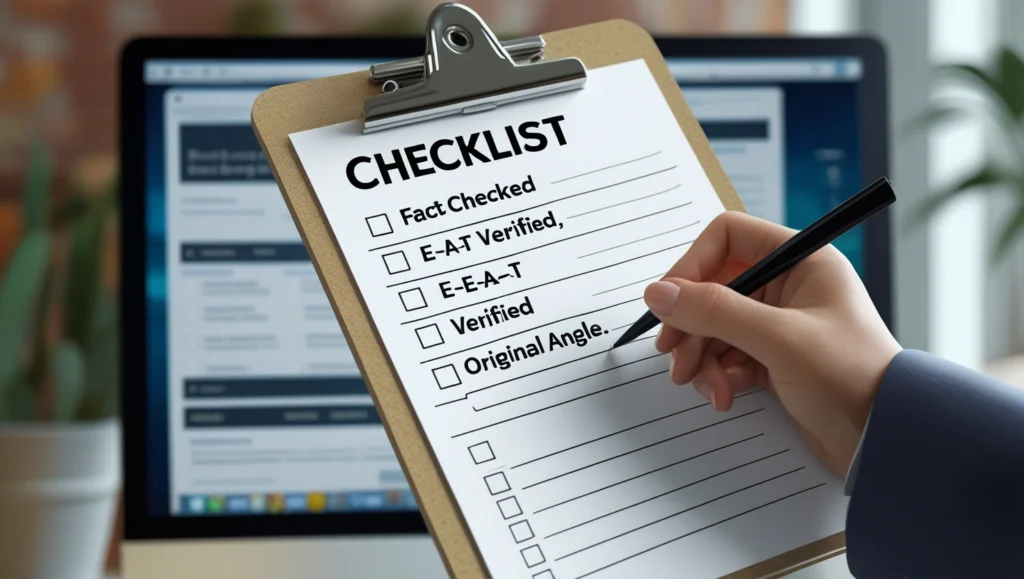
Record a decision rather than an arbitrary score
For each check, record “ready,” “needs correction,” or “not applicable,” with a reason. An unsupported central claim should not be cancelled out by good grammar or formatting. Mark the article for revision if a material issue remains.
Review this draft against the supplied brief and evidence.
For each category—reader usefulness, factual support, argument and scope, honest attribution, final-page checks—return:
Status | Specific issue | Supporting passage or requirement | Next action.
Use ready / needs correction / not assessable from supplied material.
Do not invent missing evidence, claim to inspect a page you cannot access, or certify publication readiness.
BRIEF: [paste]
DRAFT: [paste]
EVIDENCE AND PAGE DETAILS: [paste]
Check the AI review yourself. “Not assessable” is appropriate when the final page or source is unavailable. Do not substitute an invented quality score or detector result for the missing inspection.
Source and editorial approach
This proposed checklist is informed by Google’s helpful-content guidance, reviewed November 4, 2026. It is not a Google scoring system, a benchmark, or a guarantee of rankings. No fixed writing-to-editing ratio is prescribed.