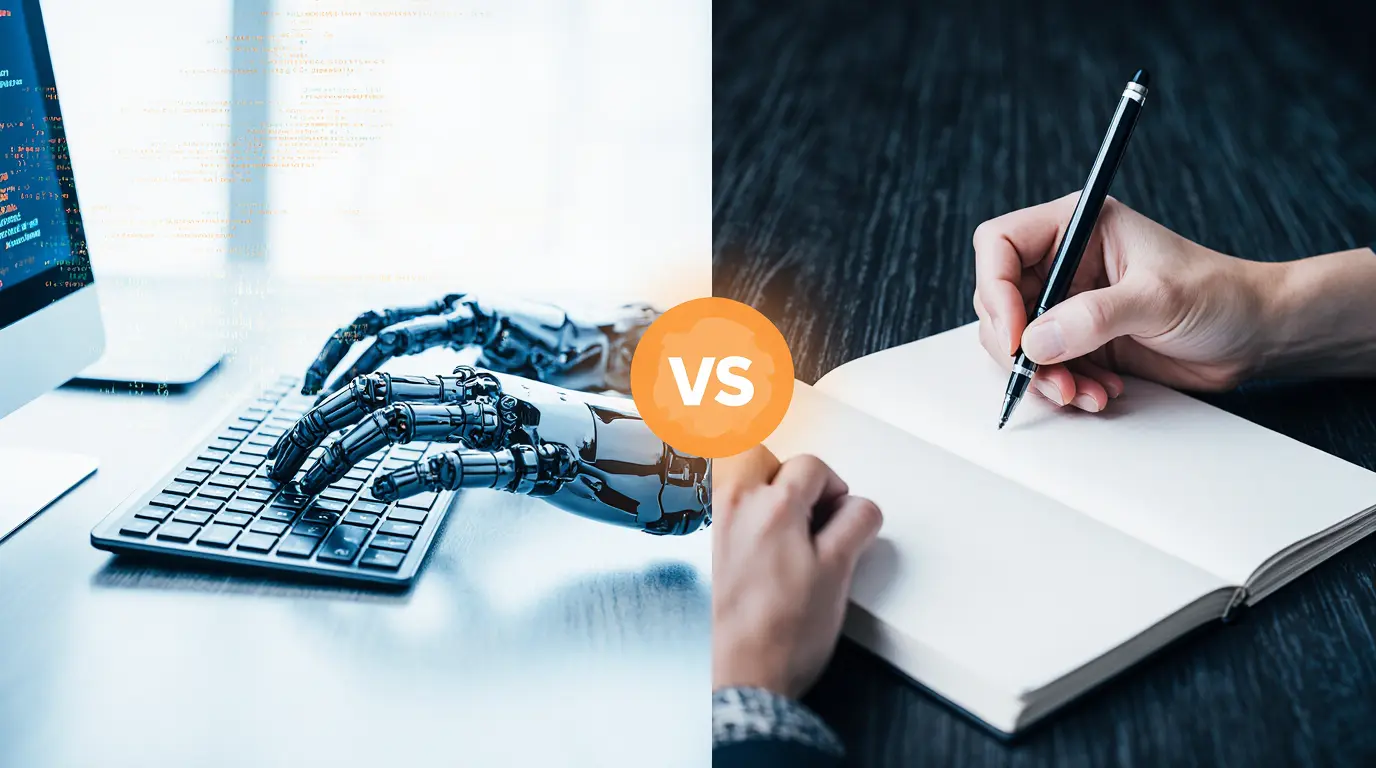
An AI vs human writer comparison needs the same brief, evidence, criteria, and a clear account of editing time. There is no defensible universal winner without a defined task and measured results. This page offers a comparison method rather than an invented scorecard.
Define what “better” means
Choose the reader, task, approved facts, and format. Evaluate factual support, completeness, clarity, useful analysis, and editing effort. A fast draft can still require extensive correction. Human authorship alone does not establish accuracy either.

Compare three workflows if useful
- A person completes the task without AI assistance.
- AI produces a draft under a documented brief.
- A person uses AI and reviews the resulting work.
Keep the starting evidence and acceptance criteria consistent. Record which tools and assistance each condition permits. Do not present a proposed evaluation as a completed experiment.
Assess content without guessing authorship
Judge the actual output against the brief and sources. Where practical, hide its origin during the initial review. Do not use stylistic stereotypes or detector scores as substitutes for evaluating facts and reader usefulness.

What research can and cannot tell you
A 2024 meta-analysis of human-AI combinations found varied outcomes by task and did not establish that combinations always outperform the stronger of either alone. It covered studies published through June 2023; it is not a current product ranking or proof about your editorial workflow.

A review prompt
Compare these drafts against the same brief and evidence.
For each, list unsupported claims, missing requirements, strengths, and corrections needed.
Quote the relevant wording.
Do not infer authorship or invent numerical scores.
Separate factual errors from style preferences.
Brief: [text]. Evidence: [sources]. Drafts: [texts].
Choose a process you can sustain
Measure correction and review as well as drafting. Keep the method that produces acceptable work for the task. See task allocation and review, article drafting, and the quality checklist.
Sources and editorial approach
Vaccaro and colleagues, Nature Human Behaviour (2024). Reviewed November 4, 2026. Examples and prompts are proposed editorial templates, not first-hand tests or measured performance results.