
An editorial point of view is a reasoned position about what matters to your reader, supported by evidence and open to revision. It can give AI-assisted content direction, but it does not replace factual accuracy, useful examples, or a sound publication process.
This guide focuses on shaping the argument. For deciding whether the finished draft is ready, use our AI content quality checklist. The examples below are hypothetical editorial exercises, not findings from first-hand tests.

Separate the position, evidence, and voice
- Position: the conclusion or recommendation you are considering.
- Evidence: the material that supports or challenges it.
- Voice: how you express the argument for the intended reader.
A conversational tone can express a weak argument. A confident opinion can still be wrong. Keep these three elements separate so a request to make the copy more persuasive does not strengthen an unsupported claim.
1. State a bounded position
Avoid slogans that promise a universal result. Explain who the recommendation serves, under which conditions, and which alternatives it concerns.
Hypothetical position: “For a small team with limited review time, updating a relevant existing article may be preferable to publishing a near-duplicate page.” This is conditional. It does not claim that updates always outperform new articles.

2. Look for evidence that could change it
List both supporting and contrary evidence. If the existing article serves a different reader task, a separate page may be useful. If you cannot compare their coverage, record the gap rather than treating the preferred conclusion as established.
Do not delete accurate contrary evidence just because it conflicts with your point of view. Address it, qualify the position, or change your recommendation. Evidence can also show that the available information does not justify a firm position.
Help me examine this proposed editorial position.
Position: [statement]
Audience and scope: [details]
Evidence: [labeled sources]
Separate supported facts, interpretations, and preferences.
Identify the strongest supported objection and the evidence that could change the position.
Do not invent sources, objections, expertise, or success probabilities.
If the evidence does not justify the position, propose a narrower claim or state that it remains unresolved.
3. Draft an argument that preserves the limits
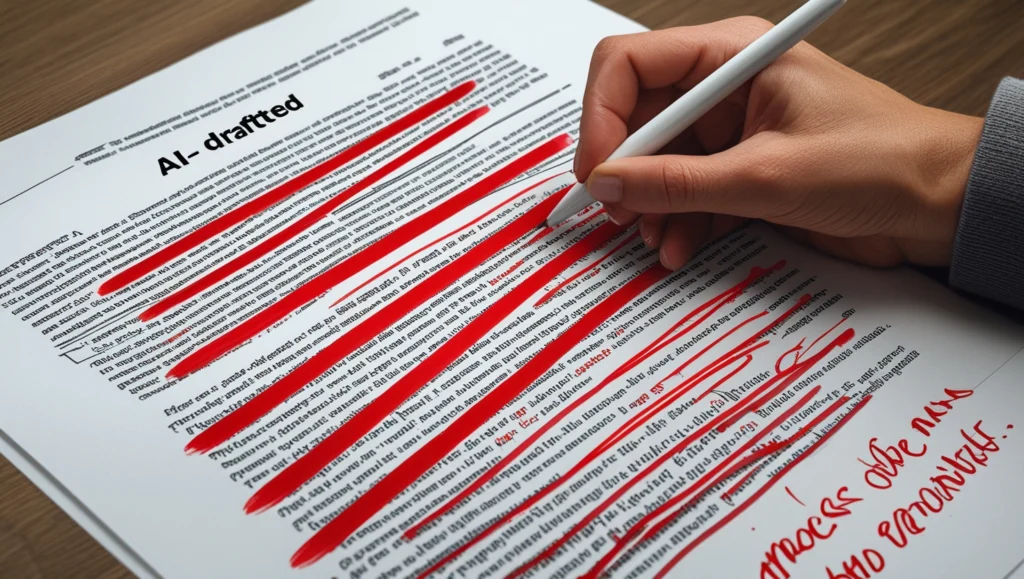
You can ask AI to help outline or draft the argument, including an introduction or conclusion. The editorial responsibility is to check the claims and decide which position is justified, not to reserve particular sections for manual typing regardless of the task.
Draft an argument from the approved material below.
Include: the reader's question, bounded position, supporting evidence, strongest relevant limitation, and practical implication.
Keep source attribution and uncertainty visible.
Do not invent first-person experience, tests, customer stories, or stronger conclusions.
Flag any sentence that needs additional evidence.
APPROVED POSITION: [paste]
EVIDENCE AND LIMITATIONS: [paste]
Compare the draft with the approved material. Remove phrases such as “the only solution” or “guaranteed” unless the evidence supports that scope. First-person opinion can clarify who is making a judgment, but “I believe” does not supply evidence.
Worked example: from a slogan to a useful claim
Before: “Publishing more content is the secret to growth.”
After: “Before increasing output, check whether existing pages answer distinct reader questions and whether you can review new drafts properly.”
The revision recommends a check rather than promising a result. Actual growth would need measurement, and the appropriate production rate depends on the site and resources. This is an illustration, not a recorded outcome.

Review the argument before publication
- Can the reader distinguish evidence from opinion?
- Does the recommendation follow from the evidence?
- Are the conditions and trade-offs visible?
- Did the revision omit an inconvenient but relevant fact?
- Does any anecdote or test claim imply experience that did not occur?
Use our thinking-partner prompts to examine assumptions, then follow the full editorial review. A distinctive argument is useful only when the reader can assess its basis.
Source and editorial approach
This proposed framework is consistent with the emphasis on sourcing, added value, and reliable presentation in Google’s helpful-content guidance, reviewed November 4, 2026. The framework and examples are editorial suggestions, not a validated ranking formula or a claim of comparative testing.