
15 Best AI Prompts to Overcome Writer’s Block (Copy & Paste)
You open a blank document, place your hands on the keyboard, and wait.
Nothing happens.
You may have a topic, a deadline, and even a rough idea of what you want to say. But the right opening, structure, or next sentence refuses to appear.
That is where AI prompts to overcome writer’s block can help.
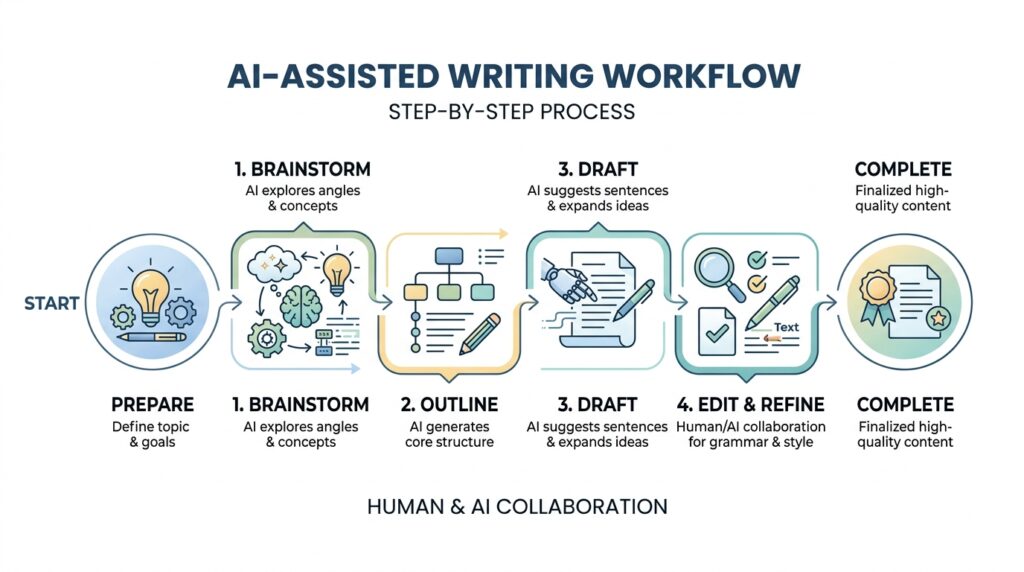
AI does not need to replace your ideas or write everything for you. Used correctly, it can act as a brainstorming partner, writing coach, interviewer, outline builder, or editor. It helps you generate movement when your thoughts feel stuck.
Below are 15 copy-and-paste prompts you can use with ChatGPT, Claude, Gemini, or another AI assistant. Each prompt solves a different type of writing block, from having no ideas to feeling trapped halfway through a draft.
Table des matières
Quick Answer: What Is the Best AI Prompt for Writer’s Block?
When you are completely stuck, begin with this simple prompt:
Act as a supportive writing coach.

I am trying to write a [type of content] about [topic] for [audience].

My goal is to help the reader [desired outcome].

Do not write the entire piece for me. Instead:

1. Ask me five questions that will uncover what I really want to say.
2. Identify the three strongest ideas from my answers.
3. Suggest a simple outline.
4. Give me three possible opening sentences.

Keep the process practical, conversational, and focused on helping me start writing.
This works because it removes the pressure to produce a perfect draft immediately. Instead, the AI helps you move through a series of smaller decisions.
Want the complete writer’s block system?
The Writer’s Block Reset includes 15 step-by-step AI prompt systems, 50+ copy-and-paste prompts, practical worksheets, a writer’s block diagnosis quiz, and a 7-day writing reset plan.
What Causes Writer’s Block?
Writer’s block does not always mean that you have run out of creativity.
You may be stuck because:
- The topic is too broad.
- You do not know your main argument.
- You are trying to perfect the first sentence.
- You have too many ideas and cannot organize them.
- You are unsure what your audience needs.
- Your draft feels repetitive or predictable.
- You are afraid that the result will not be good enough.
Writing anxiety and writer’s block are often situational rather than permanent qualities of the writer. A person may feel confident writing one type of content but blocked when facing another format, audience, or subject.
The right prompt should therefore address the specific reason you are stuck, rather than simply telling an AI tool to “write something.”
How to Use AI Prompts to Overcome Writer’s Block
Before using any of the prompts below, replace the information inside brackets with details about your project.
For example:
[topic]becomes “how freelancers can use AI.”[audience]becomes “freelance writers who are new to AI.”[type of content]becomes “blog post,” “email,” “story,” or “essay.”[goal]becomes the action or lesson you want the reader to take away.
Clear context usually produces more useful output. OpenAI’s prompting guidance recommends making instructions specific and providing relevant information about the desired context, format, audience, and result. It also recommends reviewing the first answer and refining the prompt when necessary.
Treat the first AI response as a conversation starter, not a finished product.
1. Turn a Messy Brain Dump Into Clear Ideas
Best for: When you have many disconnected thoughts but no clear direction.
Act as an experienced writing coach.

Below is a messy brain dump containing my thoughts about [topic].

Brain dump:
"""
[Paste your notes, fragments, questions, examples, and unfinished ideas]
"""

Please:

1. Group related ideas together.
2. Identify the strongest central message.
3. Remove ideas that are repetitive or unrelated.
4. Suggest three possible angles for the piece.
5. Recommend the angle that would be most useful to [target audience].
6. Create a simple outline based only on my ideas.

Do not write the full draft yet.
Why This Prompt Works
Writer’s block sometimes comes from having too many ideas, not too few.
This prompt gives the AI a limited role: organizing your existing thoughts. You remain the source of the ideas, while the AI helps reveal patterns and connections you may not have noticed.
2. Ask the AI to Interview You
Best for: When you know the topic but do not know what you want to say about it.
Interview me about [topic] so that I can discover an original idea for a [blog post/article/story/essay/newsletter].

Ask one question at a time.

Your questions should explore:

- My experience with the topic
- What I believe that others may disagree with
- Mistakes I have made
- Lessons I have learned
- Examples or stories I can share
- What I want the reader to understand

After ten questions, summarize my strongest insights and suggest three possible directions for the piece.

Do not invent experiences or opinions for me.
Why This Prompt Works
It is often easier to answer a question than to create a polished paragraph from nothing.
The interview format also helps protect your personal voice. Instead of asking AI to generate generic ideas, you use it to uncover your own experiences, opinions, and observations.
3. Find a Fresh Angle on a Familiar Topic
Best for: When your topic feels overused or predictable.
I want to write about [topic], but most existing content repeats the same advice.

Act as a creative editor and generate 10 fresh angles for this topic.

For each angle, include:

1. A one-sentence concept
2. The audience it would attract
3. Why the angle feels different
4. One possible headline
5. One real-life example or question I could explore

Avoid clickbait, exaggerated claims, and generic advice.

Prioritize practical, specific, and human-centered angles.
Why This Prompt Works
You may not be blocked by the topic itself. You may be blocked because the most obvious angle does not excite you.
Fresh angles create curiosity, and curiosity makes it easier to begin writing.
You can also explore our guide on how to use AI to generate writing prompts for additional ideation techniques.
4. Build an Outline From One Rough Idea
Best for: When you have a promising idea but cannot turn it into a complete structure.
Help me turn the following rough idea into a useful outline:

Idea:
"""
[Describe your idea in one to five sentences]
"""

The content is a [type of content] for [audience].

The reader should finish the piece knowing or being able to do the following:
Create an outline that includes:

- A compelling introduction

 - The main question or problem

- Three to five logically ordered sections

 - Practical examples for each section

 - Common mistakes or objections

 - A clear conclusion and next step

 For every section, explain in one sentence what it needs to accomplish.

 Do not write the full article
.
Why This Prompt Works
An outline removes dozens of decisions from the drafting stage.
Instead of asking, “What should I write?” you only need to answer, “What belongs in this section?”
This prompt is particularly useful before following a complete workflow for writing an article with ChatGPT.
5. Generate Better Opening Lines
Best for: When you keep rewriting the introduction and never reach the main content.
I am writing a [type of content] about [topic] for [audience].

The main message is:

Generate 10 possible opening lines using different approaches:
 1. A relatable problem
 2. A surprising observation
 3. A short personal moment
 4. A direct question
 5. A common mistake
 6. A vivid scene
 7. A bold but defensible statement
 8. A contrast
 9. A useful promise
 10. A simple, honest opening

 Keep every opening natural and specific.

 Do not use clichés such as “In today’s fast-paced world,” “Imagine a world,” or “It is no secret that.”
Why This Prompt Works
The introduction does not need to be perfect before you continue.
Choose the option that creates the most momentum, write the body, and return to the introduction later. A temporary opening is better than an empty page.
6. Continue From Your Last Sentence
Best for: When you have started the draft but do not know what comes next.
Act as a writing coach.

Here is the section I have written so far:

"""
[Paste the section]
"""

Do not continue the draft immediately.

First:

1. Summarize what this section has established.
2. Identify the question naturally forming in the reader’s mind.
3. Suggest five possible directions for the next paragraph.
4. Explain the advantage of each direction.
5. Recommend the strongest option based on clarity and flow.

After that, provide three possible first sentences for the next paragraph.

Match my existing tone without copying my sentences.
Why This Prompt Works
A weak “continue writing” command can cause AI to take control of the entire piece.
This version pauses the generation process and asks the AI to explain your options. You can then choose the direction that best reflects your intention.
7. Explain a Difficult Idea in Simple Language
Best for: When you understand the subject but cannot explain it clearly.
Help me explain [complex idea] to [target audience].

Assume the audience knows [what they already understand] but does not know [what is unfamiliar].

Please provide:

1. A plain-language explanation
2. A simple analogy
3. A concrete example
4. A common misunderstanding
5. A more precise explanation I can use after the simple version
6. Three questions a reader may still have

Avoid unnecessary jargon and do not oversimplify important details.
Why This Prompt Works
You may become stuck because you are trying to explain everything at once.
Moving from a simple explanation to an analogy and then to a precise explanation creates a natural teaching structure.
Purdue’s writing guidance similarly recommends changing the imagined audience when you are stuck, such as explaining the subject to a friend, child, or newcomer before revising it for the final audience.
Turn These Prompts Into a Complete Writing System
The prompts in this article can help you solve individual writing problems.
But if you want a structured system you can return to whenever you feel stuck, explore The Writer’s Block Reset.
The downloadable workbook includes:
- 15 complete AI prompt systems
- More than 50 copy-and-paste prompts
- Guided writing exercises
- A writer’s block diagnosis quiz
- 20 emergency micro-prompts
- A practical 7-day writing reset plan
Download The Writer’s Block Reset
8. Rewrite the Idea for a Different Audience
Best for: When your draft feels stiff, distant, or overly complicated.
Take the core idea below and explain it to five different audiences.

Core idea:
"""
[Paste your idea or paragraph]
"""

Audiences:

1. A complete beginner
2. A busy professional
3. A skeptical reader
4. A close friend
5. An expert who wants precision

For each version, show how the vocabulary, examples, level of detail, and tone should change.

Then recommend which elements I should combine for my actual audience: [describe audience].

Do not remove the central meaning.
Why This Prompt Works
Changing the audience forces you to reconsider your assumptions.
The beginner version may reveal missing explanations. The skeptical version may expose weak evidence. The friend version may uncover a more natural voice.
9. Explore the Opposite Point of View
Best for: When your argument feels one-sided or too obvious.
My current position is:

"""
[State your argument or opinion]
"""

Act as a thoughtful critic, not an aggressive opponent.

Please:

1. Present the strongest reasonable argument against my position.
2. Identify assumptions I may be making.
3. Show where my argument needs evidence or qualification.
4. Identify what both sides may agree on.
5. Suggest how I can make my position more balanced and credible.
6. Generate three questions that would deepen the discussion.

Do not use weak or unrealistic counterarguments.
Why This Prompt Works
A blank page can result from having an argument that is too simple.
Exploring a strong opposing view gives you something to respond to. It creates tension, nuance, and a clearer reason for the piece to exist.
10. Add Conflict or Stakes to a Story
Best for: Fiction, scripts, personal essays, case studies, and narrative introductions.
I am writing a scene or story with the following situation:

"""
[Describe the character, setting, goal, and current situation]
"""

The scene feels flat.

Help me identify ways to increase tension without adding random drama.

Suggest:

1. An internal conflict
2. An external obstacle
3. A difficult choice
4. A hidden piece of information
5. A time pressure
6. A misunderstanding
7. A consequence if the character fails

For each option, explain how it would affect the character and move the story forward.

Do not write the complete scene.
Why This Prompt Works
Stories become difficult to continue when nothing meaningful can change.
The AI helps you identify possible sources of tension, while you decide which conflict fits the characters and theme.
11. Diagnose Why a Paragraph Is Not Working
Best for: When you have written something but know it feels weak.
Act as a precise but constructive editor.

Analyze the paragraph below:

"""
[Paste paragraph]
"""

Do not rewrite it immediately.

Evaluate:

- Clarity
- Focus
- Logical flow
- Specificity
- Repetition
- Tone
- Sentence rhythm
- Connection to the main argument

Identify the three most important problems.

Then give me:

1. A revision plan
2. Questions I should answer
3. One lightly edited version
4. One more ambitious version

Preserve my intended meaning and avoid adding unsupported information.
Why This Prompt Works
Sometimes writer’s block appears during revision. You know that something is wrong, but you cannot identify the cause.
Separating diagnosis from rewriting gives you more control and helps you improve your editing skills.
Once the draft is complete, use the workflow in How to Humanize AI Content to remove robotic wording and preserve your individual voice.
12. Use Creative Constraints
Best for: When unlimited choices make it difficult to begin.
Give me a creative writing challenge about [topic].

Create five different constraints I could use, such as:

- A specific word limit
- A restricted point of view
- A required object or image
- A particular emotional tone
- A surprising format
- A sentence-length rule
- A time limit

The constraints should make the writing more focused and interesting, not frustrating.

After presenting the five options, recommend the one most likely to help me start quickly and explain why.
Why This Prompt Works
More freedom does not always create more creativity.
A useful constraint reduces the number of choices you need to make. Instead of inventing every element, you begin solving a smaller, more interesting problem.
13. Turn Research Into Original Questions
Best for: When you have read many sources but still do not have an argument.
I am researching [topic].

Here are my notes:

"""
[Paste research notes, quotations, statistics, or source summaries]
"""

Do not write an article from these notes.

Instead:

1. Identify recurring themes.
2. Identify contradictions or disagreements.
3. Point out unanswered questions.
4. Separate established information from assumptions.
5. Generate 10 original questions I could explore.
6. Recommend the three questions with the strongest potential for a useful article.
7. Explain what additional evidence I would need for each one.

Do not invent facts or sources.
Why This Prompt Works
Research can create the illusion of progress while delaying the moment when you must decide what you actually want to say.
This prompt transforms passive notes into questions, and strong questions often lead to stronger writing.
14. Create Transitions Between Disconnected Sections
Best for: When individual sections work but the article does not flow.
I need a natural transition between two sections.

Section A ends with:
"""
[Paste the end of the first section]
"""

Section B begins with:
"""
[Paste the beginning of the next section]
"""

Please:

1. Explain the logical relationship between the two sections.
2. Identify any missing idea the reader needs.
3. Suggest five transition options.
4. Make each option concise and natural.
5. Avoid phrases such as “Now that we have discussed” or “In the next section.”

Match the tone of my draft.
Why This Prompt Works
A transition is not merely a decorative phrase. It should show the reader why the next idea follows from the previous one.
By asking the AI to explain the logical relationship first, you receive transitions based on meaning rather than generic filler.
15. Create a 10-Minute Writing Sprint
Best for: When perfectionism or procrastination prevents you from starting.
Create a focused 10-minute writing sprint for my project.

Project:[type of content and topic]

Current stage: [idea, outline, introduction, first draft, revision, or conclusion]

My main obstacle: [describe what is stopping you]

Give me:
 1. One small objective I can complete in 10 minutes.
 2. A two-minute preparation step.
 3. A seven-minute writing task.
 4. A one-minute review step.
 5. A rule that prevents me from editing while drafting.
 6. The exact sentence I should write first.

 The objective must be realistic and produce something usable.
Why This Prompt Works
“Finish the article” is too large to be an effective immediate task.
“Write three examples for section two in seven minutes” is specific, measurable, and easier to begin.
Small writing sessions can create momentum, and momentum is often more valuable than waiting for inspiration.
A Master Prompt for Overcoming Writer’s Block
Use this prompt when you are unsure which of the 15 prompts fits your situation:
Act as a writing coach who helps writers solve creative blocks without taking over their work.

I am writing a [type of content] about [topic] for [audience].

Here is what I have so far:
"""
[Paste notes, outline, or draft]
"""

I feel stuck because:
[Describe the problem]

First, diagnose the likely type of writer’s block.

Possible causes include:

- Lack of ideas
- Too many ideas
- Unclear audience
- Weak structure
- Perfectionism
- Missing evidence
- Fear of being repetitive
- Difficulty explaining the topic
- Unclear next step

Then:

1. Explain the diagnosis.
2. Ask up to three clarifying questions.
3. Recommend one small next action.
4. Give me a customized prompt for that action.
5. Do not write the entire piece unless I explicitly request a draft.
This master prompt turns the AI into a guide rather than an automatic content generator.
Common Mistakes When Using AI for Writer’s Block
Asking AI to “Write Something”
A vague instruction produces a vague result.
Give the AI a topic, audience, goal, format, and specific task.
Requesting the Entire Draft Too Early
Generating a complete article may remove the blank page, but it can create a new problem: a generic draft that does not sound like you.
Start with questions, angles, examples, or outlines.
Accepting the First Response
The first result is a draft of the collaboration.
Tell the AI what is missing, what feels generic, which option you prefer, and what it should change.
Using AI Output Without Verification
AI tools may produce inaccurate details, unsupported claims, or invented sources.
Verify factual information before publishing it.
Removing Your Own Perspective
Your experiences, judgment, examples, humor, and opinions are what make the final writing valuable.
AI can help organize and develop those elements, but it should not replace them.
For a deeper comparison of both roles, read AI vs. Human Writer.
How to Make AI-Assisted Writing Sound Human
After using AI prompts to overcome writer’s block, revise the result manually.
Add:
- A personal observation
- A specific example
- Your natural vocabulary
- Varied sentence lengths
- Honest uncertainty where appropriate
- Details that come from real experience
- Opinions you can defend
Remove:
- Repetitive conclusions
- Empty motivational language
- Unnecessary headings
- Overused transition phrases
- Generic examples
- Claims that you cannot verify
The objective is not to hide that you used a tool. The objective is to create writing that is accurate, useful, and genuinely shaped by you.
Writers and other creative professionals can also use AI as a collaborator rather than a replacement, a mindset explored in our AI for Creative Professionals guide.
Frequently Asked Questions
Is Using AI for Writing Cheating?
That depends on the situation and the rules that apply.
Using AI to brainstorm or organize ideas may be acceptable in many personal and professional settings. Schools, employers, publishers, and clients may have specific policies about AI-generated work.
You should follow the relevant rules, disclose AI use when required, and never submit unverified AI output as original research.
How Do I Stop AI Writing From Sounding Generic?
Provide examples of your preferred tone, include personal details, request specific rather than general examples, and edit the result carefully.
You can also tell the AI what to avoid, such as clichés, exaggerated claims, repetitive conclusions, or unnecessary formality.
Can AI Really Help With Writer’s Block?
Yes. AI can help you brainstorm ideas, organize notes, generate questions, compare angles, build outlines, and evaluate drafts.
It is most useful when you give it a clearly defined role instead of asking it to produce an entire piece without guidance.
What Is the Best AI Tool for Overcoming Writer’s Block?
ChatGPT, Claude, Gemini, and similar conversational AI tools can all support brainstorming and drafting.
The quality of the result often depends more on the context and instructions you provide than on using a single “perfect” tool.
Are AI Writing Prompts Only for Blog Posts?
No. These prompts can be adapted for:
Essays
Emails
Newsletters
Social media posts
Fiction
Scripts
Speeches
Reports
Product descriptions
Academic assignments
Replace the content type, audience, tone, and desired outcome to match your project.
Ready to Stop Staring at the Blank Page?
You do not need hundreds of random prompts.
You need the right prompt for the specific reason you are stuck.
The Writer’s Block Reset gives you a complete, reusable system for generating ideas, organizing your thoughts, strengthening weak drafts, and starting to write again.
Your download includes the full PDF workbook and a separate copy-and-paste prompt library for quick access.
Get The Writer’s Block Reset Today
Final Thoughts
Writer’s block does not always disappear because you discovered one magical sentence.
It often disappears when you reduce the next step to something small and clear.
The best AI prompts to overcome writer’s block do not remove you from the creative process. They help you ask better questions, organize your thoughts, explore new directions, and begin writing before you feel completely ready.
Choose the prompt that matches your current obstacle, paste it into your preferred AI tool, and complete one small piece of the project.
You do not need to finish everything today.
You only need to create enough momentum to write the next sentence.