
To generate content ideas with ChatGPT, supply a specific audience, real questions, and your existing article list. Ask for distinct reader tasks, then check the most promising ideas against evidence before drafting. A generated title is a proposal, not proof that people search for it or that your site can answer it well.
This guide covers choosing an idea. For outlining, drafting, and publication checks after selection, use our article-writing workflow with ChatGPT. The prompts and examples below are proposed templates, not a recorded test or a guaranteed month of content.
1. Collect questions before requesting titles
Define who you help and what they are trying to accomplish. “Website owners updating old articles” is more useful than “people interested in AI.” Gather questions from relevant sources you can inspect: customer emails, comments, interviews, support records, or your own search-performance data.
Remove private information before sharing records. Keep the source and date beside each question. When a problem is only your hypothesis, label it as such rather than presenting it as a verified audience need.
Organize these questions from my audience.
Audience: [specific reader]
Site purpose: [purpose]
Questions with source labels: [paste anonymized material]
Group by the task the reader is trying to complete.
Return: reader task | exact question | source label | evidence gaps.
Keep my hypotheses separate from observed questions.
Do not invent research, search volume, popularity, or customer needs.
2. Generate distinct angles from those questions
Ask for a modest number of different answers rather than dozens of interchangeable headlines. A how-to guide, troubleshooting checklist, comparison, and worked example can serve different tasks, but a new format alone does not justify another page.
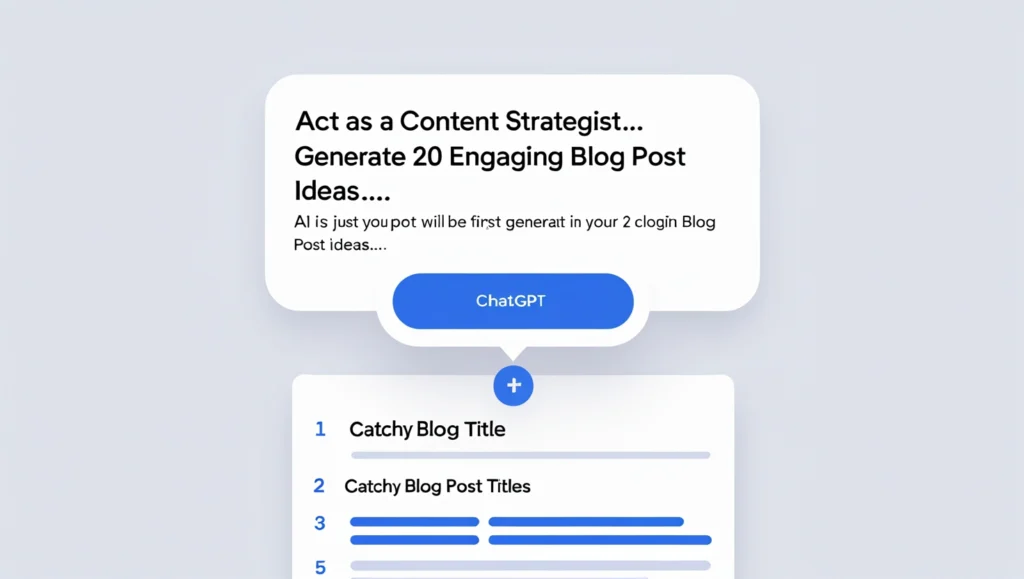
Suggest up to eight article ideas from this evidence.
Audience and site focus: [details]
Verified reader questions: [questions and sources]
Existing articles with summaries: [titles, URLs, and coverage]
For each idea give:
- Reader question and intended outcome
- Working title and suitable format
- What evidence or expertise the article would need
- Related existing page and possible overlap
Return fewer ideas if there are not enough distinct tasks.
Label inferred needs as hypotheses.
Do not claim uniqueness, popularity, or traffic potential without supplied evidence.
A role instruction such as “act as a strategist” can describe the task or perspective. It does not grant credentials, prove access to current discussions, or validate the suggestions. Review the substance of each idea.
3. Check demand, intent, and existing coverage
- Audience evidence: Does the question appear in records you can inspect, or is it only a brainstormed possibility?
- Search intent: For search-led content, inspect current results for the target country and language. Identify whether people appear to need a tutorial, comparison, tool, or another page type.
- Search estimates: Record the source, date, location, and wording behind volume or difficulty figures. Missing data and an estimated zero are not proof of no demand.
- Existing coverage: Compare the proposed answer with the actual content of related pages, not just their titles.
- Ability to deliver: Confirm that you can obtain the evidence, examples, and review the topic requires.
Search Console can provide evidence of queries associated with your own site’s search appearances. It is not a complete market-demand database. Google explains that some queries are omitted for privacy and reporting has limits. An absent query does not establish that nobody searches for it.
Do not ask ChatGPT to fill missing keyword metrics with guesses. If estimates are unavailable, record that limitation and decide whether audience evidence or a small exploratory article justifies the work.
4. Choose new article, update, or defer
Prefer an update when a relevant existing page can answer the question within its current purpose. Consider a new page when the reader needs a materially different answer. Defer when the idea depends on evidence you cannot yet obtain.
Compare these shortlisted ideas using only the evidence below.
For each, recommend: new article / update an existing page / defer.
Explain:
- Reader task and evidence of need
- Existing coverage and meaningful difference
- Sources or expertise available
- Production requirements and unresolved risks
Do not rank by search volume alone.
Do not invent scores, traffic forecasts, or success probabilities.
If evidence is insufficient to choose, state the next useful check.
IDEAS AND EVIDENCE: [paste]
The illustration is a visual example of brainstorming, not evidence that the pictured ideas have verified demand.
Worked example: one topic, three possible tasks
Consider a hypothetical site helping bloggers review AI-assisted drafts. “How do I verify an AI citation?” could support a source-checking guide. “How do I rewrite an awkward sentence?” could support before-and-after editing examples. “How do I review a full draft before publishing?” could support an editorial workflow.
Those tasks may justify distinct pages if the answers differ substantially. In contrast, “humanize AI text” and “make AI writing sound human” may lead to the same answer. Inspect the existing pages and search results before deciding. The wording alone does not settle the architecture.
5. Turn the chosen idea into a brief
Record the reader question, intended outcome, scope, evidence, and related pages. This prevents the draft from drifting into a general overview and repeating articles you already have.
Create a concise brief for the selected idea.
Reader question: [question]
Reader outcome: [outcome]
Approved evidence: [sources]
Existing related pages: [URLs and coverage]
Include: scope, exclusions, essential sections, evidence gaps, and relevant internal links from the supplied list.
Do not add unsupported claims or invent URLs.
Stop at the brief; do not draft the article yet.
Move to the article-writing workflow once the brief is ready. For comparing uncertain choices, use our AI thinking-partner prompts. Repurpose approved articles later with our social media content workflow.
Common questions
Are ChatGPT ideas original? Do not assume so. Check related coverage and decide what useful evidence or explanation your page adds. A different headline does not necessarily mean a different idea.
How many ideas should I request? Request a shortlist you can evaluate. Generating more titles does not establish more opportunities.
Can I use these ideas without keyword data? You can make an editorial decision based on other reliable evidence, but describe the uncertainty honestly. Do not present an unmeasured topic as a proven search opportunity.
Sources and editorial approach
This is a proposed editorial process, not a keyword-demand study. Its prompting approach is informed by OpenAI’s prompting guidance; the search-data limitation is documented by Google Search Central. Sources reviewed November 4, 2026.






2 Comments
Comments are closed.