
AI for decision making can help organize options, criteria, evidence, and unknowns. It is not automatically objective, and a detailed response is not a verified forecast. Use the analysis to identify what to check before committing resources.
Frame the actual choice
Name the decision, deadline, options, and constraints. Include keeping the current approach or deferring when appropriate. Identify who owns the decision and who is affected. Use approved data instead of a fictional business case.
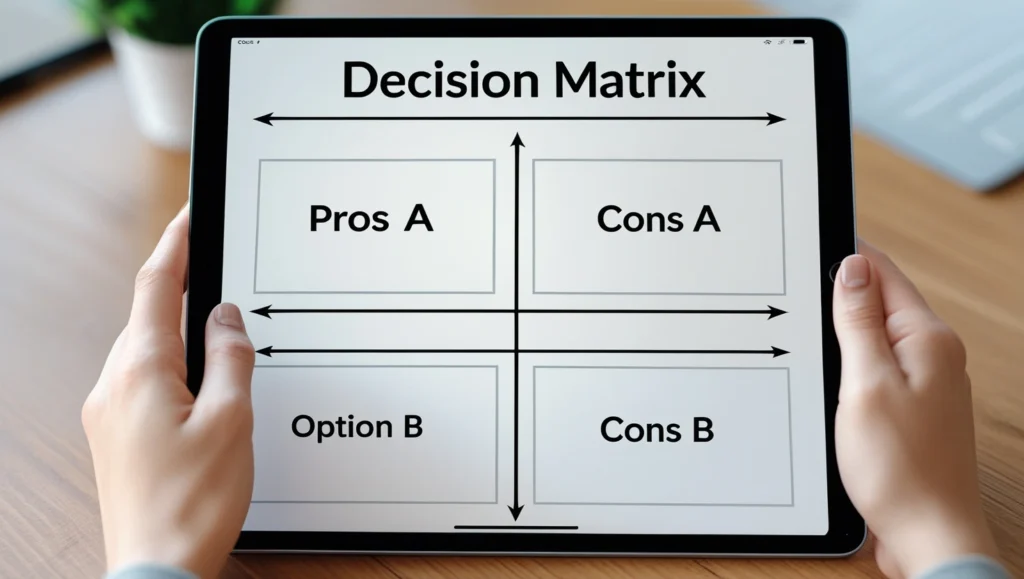
Use an evidence-based comparison prompt
Decision: [decision]. Options: [list].
Priorities and constraints: [details]. Evidence: [sources].
For each option, separate supported benefits, drawbacks, assumptions, and missing evidence.
Explain trade-offs using the criteria I supply.
If using weights or scores, ask for or label them as proposed judgments; do not invent evidence for a score.
Treat best/worst cases as hypothetical scenarios, not probabilities.
State what would change the recommendation.
Check generated scenarios
The model cannot infer market share, margins, break-even dates, or hiring savings from an idea alone. Supply validated inputs and inspect the calculation. If the data is missing, the correct output may be a list of information needed.
Illustrative editorial decision
A site owner must choose between updating an existing guide and writing a related article. Compare the reader tasks, current coverage, available evidence, and production capacity. Do not create a new page just because a generated title sounds appealing. This is a hypothetical example, not a measured case study.
Avoid automatic agreement or opposition
Ask for the strongest supported counterargument and the uncertainty that matters most. Neither a simulated expert panel nor a second model provides independent evidence. Thinking-partner prompts can structure the discussion.
Record the decision
Keep the evidence, assumptions, chosen option, responsible owner, and review condition. Revisit when material information changes. For implementation, use the workflow pilot guide rather than treating the analysis as permission to execute.
Sources and editorial approach
Context: NIST’s voluntary AI Risk Management Framework. The workflows below are editorial proposals, not NIST certification or measured business savings. Reviewed November 4, 2026. Examples and prompts are proposed editorial templates, not first-hand tests or measured performance results.






One Comment
Comments are closed.