
Human-AI Collaboration: How to Use AI as a Thinking Partner (With Real Examples)
Stop Asking AI for Answers. Start Using It to Think Better.
Most people use AI like a search engine.
They ask a question.
AI provides an answer.
The conversation ends.
That was exactly how I started.
My first prompt had nothing to do with business, writing, or productivity. I simply asked ChatGPT for a cookie recipe. It gave me a good answer, and I moved on.
Later, I began using AI to write articles, summarize documents, brainstorm ideas, improve emails, and automate repetitive work.
It saved me hours every week.
But I eventually realized I wasn’t using AI to its full potential.
The biggest value of AI isn’t writing faster.
It isn’t generating longer articles.
It isn’t replacing human intelligence.
Its greatest strength is helping us think more clearly.
Everything changed when I stopped asking AI to solve my problems and started asking it to challenge my thinking.
Today, AI is no longer just my assistant.
It has become my thinking partner.
In this guide, I’ll explain exactly how I use Human-AI Collaboration every day, the framework I follow before making important decisions, the prompts that consistently improve my thinking, and the lessons I’ve learned after hundreds of conversations with AI.
Whether you’re a business owner, creator, manager, student, or simply curious about artificial intelligence, this approach can help you make better decisions while keeping humans at the center of the process.
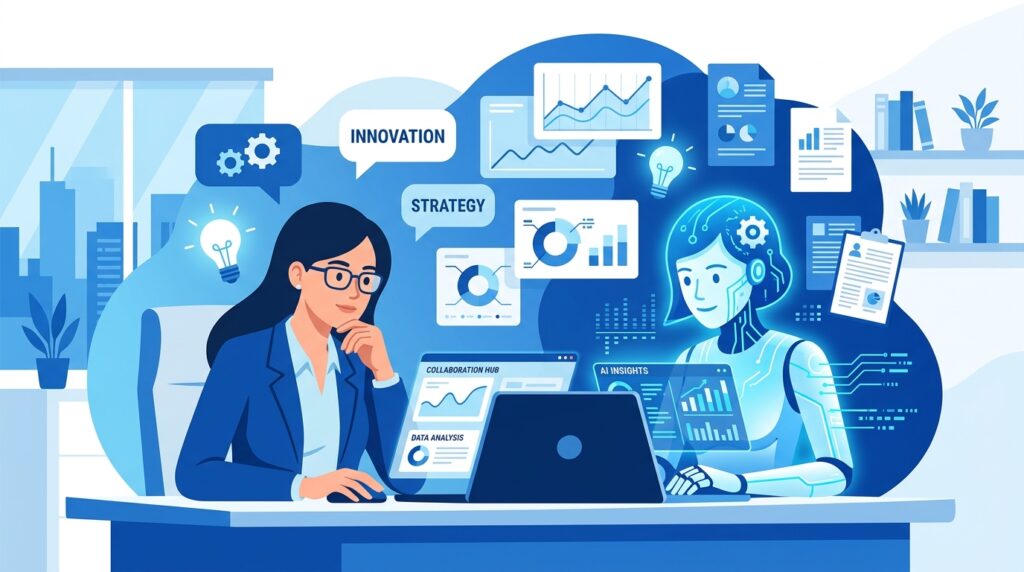
Table of Contents
- What Is Human-AI Collaboration?
- Why Most People Use AI the Wrong Way
- My Journey From AI Assistant to Thinking Partner
- The Turning Point That Changed Everything
- The Human-AI Thinking Framework
- Real Conversation Example
- The Biggest Mistakes People Make
- Best Prompts for Better Thinking
- When AI Is Wrong
- Frequently Asked Questions
- Final Thoughts
What Is Human-AI Collaboration?
Human-AI Collaboration is the process of combining human judgment, creativity, experience, and critical thinking with artificial intelligence to produce better outcomes than either humans or AI could achieve independently.
Contrary to popular belief, the goal isn’t to replace humans.
The goal is to improve human thinking.
AI is exceptionally good at processing information, generating alternatives, identifying patterns, and exploring multiple perspectives.
Humans remain responsible for context, ethics, experience, intuition, creativity, and final decisions.
The most successful professionals won’t be those who simply use AI.
They will be those who know how to collaborate with it.
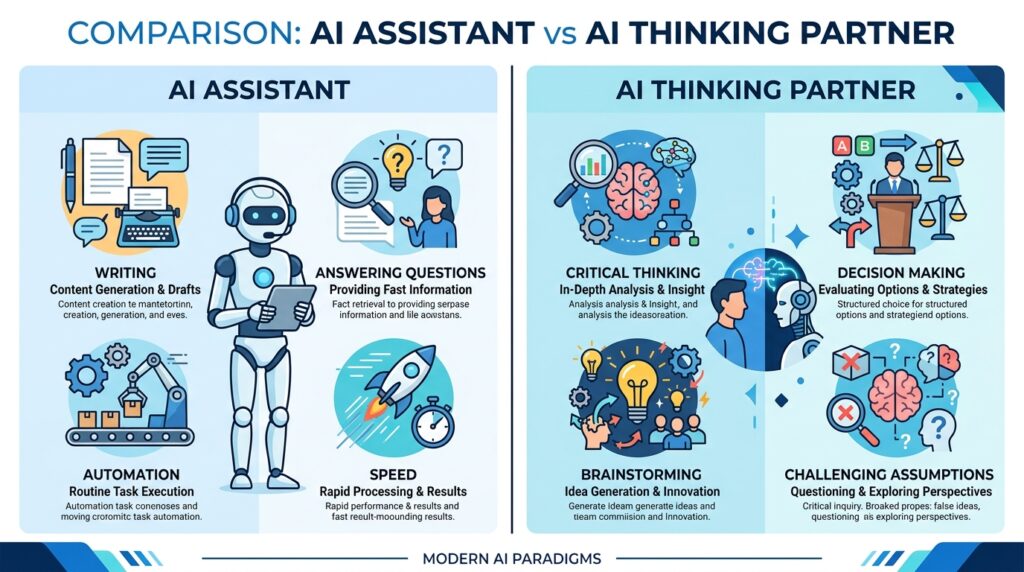
AI Assistant vs AI Thinking Partner
| AI Assistant | AI Thinking Partner |
|---|---|
| Executes tasks | Challenges assumptions |
| Generates answers | Improves reasoning |
| Saves time | Improves decisions |
| Follows instructions | Offers alternative perspectives |
| Produces content | Strengthens ideas |
Most people stay in the first column.
The real competitive advantage lies in the second.
Why Most People Use AI the Wrong Way
Since tools like ChatGPT became popular, millions of people have adopted the same workflow.
Ask.
Receive.
Copy.
Repeat.
This approach is fast, but it has one major weakness.
It assumes the AI’s first answer is good enough.
In reality, AI isn’t designed to think for you.
It predicts the most likely response based on patterns in its training data.
That prediction can be useful.
It can also be incomplete, biased, or simply wrong.
If you accept every answer without questioning it, you’re outsourcing your thinking instead of improving it.
That’s why I stopped treating AI as a content generator.
I started treating it like someone sitting across the table during an important meeting.
Someone whose role isn’t to agree with me.
Someone whose role is to ask difficult questions.
My Journey From AI Assistant to Thinking Partner
Like many beginners, I initially used AI for simple tasks.
Recipes.
Translations.
Summaries.
Emails.
Later, when I created The Human Prompts, my workflow became much more advanced.
I wrote increasingly detailed prompts.
I specified the audience.
I defined the writing style.
I listed keywords.
I described the article structure.
The results improved dramatically.
AI became my fastest assistant.
It could produce a complete first draft in minutes.
From a productivity perspective, it was incredible.
But after publishing more articles, I noticed a recurring problem.
Everything sounded good.
Everything looked professional.
Yet many ideas lacked originality.
The content answered questions.
It didn’t challenge assumptions.
It explained concepts.
It rarely created new perspectives.
Without realizing it, I was asking AI to confirm my thinking rather than improve it.
That realization completely changed my workflow.
Instead of asking:
« Write this article. »
I began asking:
« Challenge this idea. »
That small change transformed every conversation I had with AI.
The Turning Point
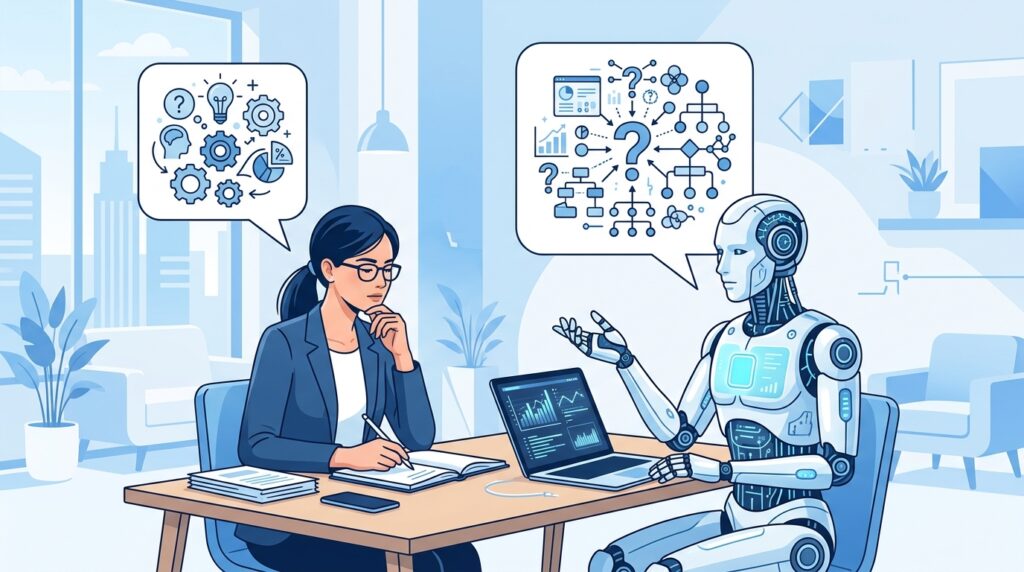
One day, while planning the future direction of my website, I wrote a prompt that I had never used before.
Instead of asking AI to help me execute my strategy, I asked it to criticize it.
My prompt was simple.
Act as an experienced business strategist.
My current assumption is:
« Publishing practical AI tutorials is the best long-term strategy for my website. »
Challenge this assumption.
What weaknesses do you see?
What important opportunities am I ignoring?
If you completely disagreed with me, what would your argument be?
The response surprised me.
The AI didn’t tell me I was wrong.
Instead, it revealed something I hadn’t considered.
Practical tutorials solve immediate problems.
But they don’t always build lasting authority.
Many visitors read a tutorial, solve their problem, and never return.
Strategic articles, frameworks, and original thinking create a stronger reason for readers to come back.
That conversation fundamentally changed how I think about content creation.
The AI didn’t replace my judgment.
It expanded it.
That is the essence of Human-AI Collaboration.
Instead of generating answers, AI became a mirror that reflected the strengths and weaknesses of my own thinking.
Related Guides
• Advanced Prompt Engineering for Business
• AI for Decision Making
• AI Hallucination Explained
• AI Process Improvement
• Prompt Engineering Explained
For readers interested in the questioning technique behind this approach, the Socratic method is a useful concept to explore. It emphasizes learning through thoughtful questions rather than simply accepting answers. See: Socratic method (Wikipedia).
The Human-AI Thinking Framework
After hundreds of conversations with AI, I realized that the quality of the results depends far less on the AI model and far more on the quality of the thinking process.
Today, almost every important decision follows the same five-step framework.
It doesn’t matter whether I’m writing an article, planning a business strategy, solving a problem, or learning a new topic.
The process remains the same.
Step 1 – Define Your Assumption
Every project starts with an assumption.
Unfortunately, most assumptions remain hidden.
Writing them down forces you to think clearly.
Examples:
- My audience wants more AI prompts.
- This article is ready to publish.
- My marketing strategy is working.
- This feature will improve my product.
- This is the best solution.
Don’t try to prove your assumption.
Simply make it visible.
The clearer your assumption is, the easier it becomes to challenge.
Step 2 – Invite AI to Disagree
This is where the collaboration begins.
Instead of asking AI for confirmation, ask it to disagree.
Some of my favorite prompts include:
Challenge my assumptions.
What’s the strongest argument against my idea?
If you were my biggest competitor, what weaknesses would you exploit?
What am I not seeing?
Which assumptions lack evidence?
This simple change transforms AI from an assistant into a critical thinking partner.
Step 3 – Identify Blind Spots
Every person has blind spots.
Experience creates them.
Success creates them.
Confidence creates them.
AI is surprisingly good at identifying perspectives you may have ignored.
It may reveal:
- missing evidence;
- alternative strategies;
- hidden risks;
- unrealistic expectations;
- contradictory information;
- overlooked opportunities.
Not every suggestion will be correct.
That’s perfectly normal.
Your goal isn’t to accept every answer.
Your goal is to discover ideas worth investigating.
Step 4 – Improve the Original Idea
Once you’ve explored different perspectives, return to your original idea.
Ask yourself:
- Which criticisms are valid?
- Which arguments remain strong?
- What should I change?
- What evidence do I need?
This step is where human judgment matters most.
AI provides possibilities.
Humans make decisions.
Step 5 – Repeat the Process
Great thinking is iterative.
The first version is rarely the best.
Every conversation reveals new questions.
Every revision improves clarity.
Sometimes I repeat this process three or four times before making an important decision.
The final result is almost always stronger than my original idea.
A Real Conversation With AI
Here’s a simplified version of a real discussion that changed the way I approach content strategy.
My Original Idea
I should publish more AI tutorials because tutorials generate traffic.
AI Response
Tutorials solve immediate problems, but how will readers remember your website instead of dozens of similar blogs?
My Reflection
The question forced me to think differently.
I realized I had been optimizing for search traffic rather than long-term authority.
My New Strategy
Instead of publishing more tutorials, I decided to create:
- original frameworks;
- personal experiences;
- decision-making guides;
- Human-AI Collaboration articles;
- strategic content instead of only instructional content.
The AI didn’t give me the answer.
It asked the question that helped me discover it.
Where Human-AI Collaboration Works Best
This method isn’t limited to writing.
I use it across many areas of my work.
Business Strategy
Before launching a new project, I ask AI to identify risks I may have overlooked.
Questions like:
- Why could this fail?
- Which customers would disagree?
- What assumptions have no evidence?
often reveal weaknesses before they become expensive mistakes.
Writing
Instead of asking AI to write the article, I ask it to improve my thinking before writing begins. If you’re new to prompting, start with Prompt Engineering Explained.
The article becomes more original because the ideas are stronger.
Decision Making
Whenever I’m choosing between multiple options, I ask AI to compare each one objectively.
I don’t ask:
Which one is best?
I ask:
Compare the advantages, disadvantages, risks, and trade-offs of each option.
This produces much better discussions.
Learning
When studying a new topic, I ask AI questions like:
- Explain this from three different perspectives.
- Which experts disagree?
- What are the common misconceptions?
- What’s the historical context?
This helps me develop a deeper understanding instead of memorizing isolated facts.
Problem Solving
Sometimes the biggest obstacle isn’t finding solutions.
It’s defining the problem correctly.
AI often helps me reframe the question itself.
That alone can completely change the outcome.
The Biggest Mistakes People Make
Mistake #1 – Accepting the First Answer
AI’s first answer is only a starting point.
The best conversations begin after the first response.
Mistake #2 – Asking Vague Questions
Questions like:
Tell me about AI.
produce generic answers.
Specific questions create useful conversations.
Mistake #3 – Looking Only for Confirmation
If AI always agrees with you, you’re learning very little.
Growth begins when your assumptions are challenged.
Mistake #4 – Believing AI Is Always Right
Large Language Models generate probable answers.
They do not guarantee factual accuracy.
Always verify important information using reliable sources.
Mistake #5 – Confusing Speed With Quality
Producing content faster doesn’t automatically create better work.
Human-AI Collaboration is about improving quality before increasing speed.
My Favorite Thinking Prompts
Challenge My Assumptions
Challenge every assumption I’m making.
Which assumptions are unsupported?
What evidence contradicts my thinking?
Devil’s Advocate
Act as someone who completely disagrees with me.
Convince me my idea will fail.
Blind Spot Finder
What important perspective am I missing?
Strategic Review
If you were my competitor, how would you beat me?
Better Decisions
Compare three possible decisions.
Explain the trade-offs.
Recommend one and justify your recommendation.
Improve My Reasoning
Ask me five difficult questions before answering.
Second Perspective
Ignore your previous answer.
Solve the problem using a completely different approach.
Simplify Complexity
Explain this idea as if you were teaching a complete beginner.
Related Articles
Continue exploring Human-AI Collaboration with these guides:
- Advanced Prompt Engineering for Business
- AI for Decision Making
- AI Hallucination Explained
- AI Process Improvement
- Prompt Engineering Explained
- AI Productivity
For practical guidance on evaluating AI systems and managing risks, the NIST AI Risk Management Framework offers a widely recognized framework that complements the collaborative approach described in this article.
Frequently Asked Questions
What is Human-AI Collaboration?
Human-AI Collaboration is the process of combining human judgment, creativity, experience, and critical thinking with artificial intelligence to achieve better results. Instead of replacing people, AI supports decision-making, brainstorming, problem-solving, and learning while humans remain responsible for context, ethics, and final decisions.
Is AI a good thinking partner?
Yes, when used correctly.
AI is particularly effective at:
- challenging assumptions;
- identifying blind spots;
- generating alternative ideas;
- comparing multiple options;
- asking difficult questions;
- organizing complex information.
However, AI should support your thinking—not replace it.
Can AI improve critical thinking?
It can.
When you ask AI to challenge your ideas instead of confirming them, it encourages deeper reflection and exposes weaknesses in your reasoning.
Critical thinking remains a human skill, but AI can accelerate the process.
Should I trust AI’s answers?
Not blindly.
Large Language Models generate responses based on patterns in data. They may produce incorrect information, outdated facts, or overly confident conclusions.
For important decisions, always verify information using reliable sources and your own judgment.
Which AI model works best for collaboration?
The quality of your collaboration depends more on your questions than on the specific AI model.
Whether you use ChatGPT, Claude, Gemini, or another capable assistant, asking thoughtful, challenging questions will usually have a greater impact than switching models.
Can beginners use this approach?
Absolutely.
You don’t need advanced prompt engineering skills.
Start by replacing questions like:
« Give me the answer. »
with:
« Help me think about this problem. »
That small change often leads to much more valuable conversations.
When should I avoid relying on AI?
AI should never be your only source for:
- medical advice;
- legal decisions;
- financial investments;
- safety-critical situations;
- information requiring real-time verification.
In these cases, AI can support research, but qualified professionals and trusted sources should guide the final decision.
Can Human-AI Collaboration improve creativity?
Yes.
One of AI’s greatest strengths is generating alternative perspectives.
It can suggest ideas you may not have considered, helping you overcome creative blocks while leaving the final creative direction in your hands.
Key Takeaways
Before you leave, remember these principles:
- AI is most valuable when it improves your thinking, not when it replaces it.
- Strong questions create stronger conversations.
- Your first idea is rarely your best idea.
- Challenge assumptions before making important decisions.
- AI provides perspectives; humans provide judgment.
- Collaboration creates better outcomes than automation alone.
Recommended Reading
If you’d like to continue improving your AI skills, these guides expand on the concepts introduced in this article:
- Prompt Engineering Explained
- Advanced Prompt Engineering for Business
- AI for Decision Making
- AI Process Improvement
- AI Hallucination Explained
- Comparison of AI Models
- How to Humanize AI Content
Together, these articles form the foundation of a Human-AI Collaboration workflow—from asking better questions to making better decisions.
Final Thoughts
When artificial intelligence became widely available, many people asked the same question:
« Will AI replace humans? »
After hundreds of hours working with AI, I believe that’s the wrong question.
The better question is:
« How can humans and AI think better together? »
AI can analyze information faster than we can.
It can generate ideas in seconds.
It can summarize books, organize research, compare alternatives, and explain complex topics.
But it doesn’t understand your values.
It doesn’t know your goals.
It doesn’t carry responsibility for the decisions you make.
That’s where humans remain essential.
The future doesn’t belong to people who simply use AI.
It belongs to people who know when to trust it, when to challenge it, and when to rely on their own judgment.
For me, AI is no longer a chatbot.
It’s not a replacement for creativity.
It’s not a shortcut.
It’s a thinking partner.
Every important project now begins with a conversation.
Not because AI has the answers.
But because asking better questions leads to better thinking.
And better thinking leads to better decisions.
If there’s one idea I hope you take away from this guide, it’s this:
The greatest value of AI isn’t giving you better answers. It’s helping you ask better questions.
That’s the true power of Human-AI Collaboration.
The Turning Point
One day, while planning the future direction of my website, I wrote a prompt that I had never used before.
Instead of asking AI to help me execute my strategy, I asked it to criticize it.
My prompt was simple.
Act as an experienced business strategist.
My current assumption is:
« Publishing practical AI tutorials is the best long-term strategy for my website. »
Challenge this assumption.
What weaknesses do you see?
What important opportunities am I ignoring?
If you completely disagreed with me, what would your argument be?
The response surprised me.
The AI didn’t tell me I was wrong.
Instead, it revealed something I hadn’t considered.
Practical tutorials solve immediate problems.
But they don’t always build lasting authority.
Many visitors read a tutorial, solve their problem, and never return.
Strategic articles, frameworks, and original thinking create a stronger reason for readers to come back.
That conversation fundamentally changed how I think about content creation.
The AI didn’t replace my judgment.
It expanded it.
That is the essence of Human-AI Collaboration.
Instead of generating answers, AI became a mirror that reflected the strengths and weaknesses of my own thinking.
Frequently Asked Questions (FAQ)
What is Human-AI Collaboration?
Human-AI Collaboration is the process of combining human intelligence with artificial intelligence to achieve better outcomes than either could achieve alone. Instead of replacing human thinking, AI supports it by generating ideas, identifying patterns, challenging assumptions, and providing alternative perspectives. Humans remain responsible for judgment, ethics, creativity, and final decisions.
How is AI different from a thinking partner?
A traditional AI assistant focuses on completing tasks such as writing, summarizing, or answering questions. A thinking partner, however, helps improve your reasoning by questioning your assumptions, exploring different perspectives, and encouraging critical thinking. The goal is not simply to produce answers but to make better decisions.
Can AI improve critical thinking?
Yes. AI can strengthen critical thinking when used to challenge your ideas instead of confirming them. By asking AI to identify weaknesses, alternative viewpoints, and potential risks, you are encouraged to evaluate your assumptions more carefully. The thinking process remains human, while AI acts as a catalyst for deeper analysis.
Which AI model is best for collaboration?
There is no single best AI model for collaboration. ChatGPT, Claude, Gemini, and other advanced language models all have strengths. The quality of your collaboration depends more on the questions you ask than on the model you choose. Clear objectives, thoughtful prompts, and follow-up questions usually have a greater impact than switching between AI tools.
Can AI replace human judgment?
No. AI can analyze information and suggest possible solutions, but it cannot replace human judgment. Important decisions require experience, emotional intelligence, ethical reasoning, and an understanding of context—qualities that remain uniquely human. AI should support decision-making, not make decisions on your behalf.
How do I ask AI better questions?
Start by asking open-ended questions that encourage analysis instead of simple answers. Rather than asking, « Is this a good idea? », ask, « What weaknesses do you see in this idea? » or « What important perspectives am I missing? » The more specific and thought-provoking your questions are, the more valuable AI’s responses become.
Can beginners use this method?
Absolutely. You don’t need advanced prompt engineering skills to collaborate effectively with AI. Beginners can start by using AI as a brainstorming partner, asking it to explain concepts, compare alternatives, or challenge assumptions. As your experience grows, your conversations with AI will naturally become more productive.
What are the biggest mistakes people make when using AI?
The most common mistakes include accepting the first answer without questioning it, asking vague questions, relying on AI without verifying important information, using AI only to generate content, and expecting AI to replace human expertise. The best results come from treating AI as a collaborative partner rather than an automated answer machine.
How can Human-AI Collaboration improve productivity?
Human-AI Collaboration improves productivity by helping people make better decisions before taking action. AI can organize information, generate ideas, summarize research, identify risks, and automate repetitive tasks, allowing humans to focus on creativity, strategy, and problem-solving. The result is not only faster work but also higher-quality outcomes.
Is Human-AI Collaboration the future of work?
Yes. As AI becomes more integrated into everyday work, the most valuable professionals will be those who know how to collaborate effectively with intelligent systems. Rather than replacing jobs, AI is changing how work is performed. The future belongs to people who combine human creativity, critical thinking, and decision-making with the speed and analytical capabilities of AI.